
September 20, 2026
How to Choose the Right Brazil Power Cord for Your Appliance
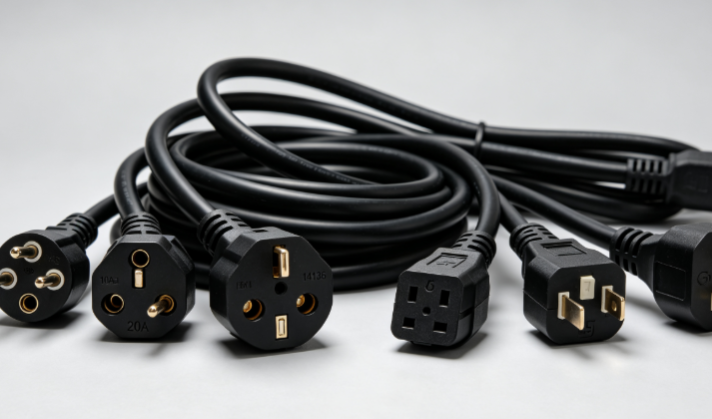
Table of Contents
Introduction
Understanding the Regulatory Framework – NBR 14136 and INMETRO
Plug Types and Current Ratings – The Physical Difference
Common Appliance Connectors – Matching the Device End
Cable Construction and Specifications
Safety and Certification – What to Look For
Practical Selection Guide
Conclusion
Frequently Asked Questions (FAQ)
1. Introduction
Brazil‘s electrical plug and socket system has undergone a significant transformation over the past two decades. For years, the country used a confusing mix of European-style two-pin plugs, American-style flat-pin plugs, and various adapters—creating confusion for consumers and safety hazards for manufacturers. That ended with the adoption of NBR 14136 in 2007, which became mandatory in 2010.
The new standard standardized everything. It eliminated the proliferation of different plug types and created a single, modern, and safer system. Today, any appliance sold in Brazil must comply with NBR 14136 and carry INMETRO certification—the Brazilian national certification body.
For procurement professionals, manufacturers, and consumers, understanding these requirements is not optional. A power cord that meets the standard in every other way will not work—or worse, will not be legal—if it does not comply with NBR 14136.
2. Understanding the Regulatory Framework – NBR 14136 and INMETRO
2.1 NBR 14136 – The Brazilian Standard
NBR 14136 is the Brazilian technical standard for plugs and socket-outlets. It was based on the international IEC 60906-1 standard, which was intended to become a universal plug standard but never achieved widespread adoption outside of Brazil and South Africa.
The Brazilian standard is not identical to IEC 60906-1. The IEC standard specifies a pin diameter of 4.5 mm and a current rating of 16 A. NBR 14136, however, defines two distinct versions: a 10 A version with 4.0 mm pins and a 20 A version with 4.8 mm pins. Brazil‘s choice to split the current ratings into two distinct physical sizes makes it safer than the IEC version—you cannot accidentally plug a high-current appliance into a low-current socket.
Key dates:
1998: NBR 14136 adopted as a national standard
2007: Voluntary adoption period began
January 1, 2010: NBR 14136 became mandatory for all new appliances sold in Brazil
2.2 INMETRO – The Certification Authority
INMETRO (Instituto Nacional de Metrologia, Qualidade e Tecnologia) is Brazil‘s national metrology and quality institute. For power cords, INMETRO certification is mandatory.
A power cord exported to Brazil must have:
An INMETRO-approved plug meeting NBR 14136 specifications
The INMETRO mark on the product or packaging
Certification through a local Brazilian representative (required by INMETRO rules)
Products without INMETRO certification cannot be legally sold or used in Brazil.
3. Plug Types and Current Ratings – The Physical Difference
The plug is the distinguishing feature of a Brazil power cord. NBR 14136 defines two plug variants, differentiated by pin diameter and current rating.
Feature | 10A Plug | 20A Plug |
Pin Diameter | 4.0 mm | 4.8 mm |
Pin Length | 19.0 mm | 19.0 mm |
Current Rating | 10 A | 20 A |
Configuration | 3-pin grounded | 3-pin grounded |
Typical Applications | General appliances, computers, lamps, small electronics | Microwave ovens, air conditioners, large power tools |
Data compiled from multiple sources
The Type N plug is the official standard. It has three round pins arranged in a triangular pattern on a hexagonal base. The grounding pin is offset 3.0 mm from the center axis. Some devices with double insulation use a 2-pin ungrounded version.
Important: The 10 A and 20 A plugs are not interchangeable. The different pin diameters prevent a 20 A plug from being inserted into a 10 A socket. This physical incompatibility prevents overloading a circuit.
Compatibility with older plugs: NBR 14136 sockets are also designed to accept the older European-style Type C (two-pin, ungrounded) plugs. This means a device with a legacy plug may still work in a modern Brazilian socket—but it will not be grounded.
4. Common Appliance Connectors – Matching the Device End
The plug is only half the story. The other end of the power cord must match the appliance‘s power inlet. The most common connectors are defined by IEC 60320—an international standard for appliance couplers.
Connector Type | Current Rating | Description | Typical Applications |
C13 | 10 A | Standard "kettle lead" connector | Computers, monitors, printers, most consumer electronics |
C15 | 10 A | Similar to C13 but with a notch; heat-resistant | Electric kettles, rice cookers, high-heat appliances |
C19 | 16 A | Larger than C13; high-current | Servers, network equipment, UPS systems, PDUs |
C5 | 10 A | "Mickey Mouse" or "cloverleaf" | Some laptop power adapters |
C7 | 2.5 A | "Figure-8" or "infinity" connector | Audio/video equipment, game consoles, some laptop adapters |
The connector must match the appliance‘s inlet. A C13 cord cannot fit a C19 inlet. Always verify the appliance‘s connector type before ordering.
5. Cable Construction and Specifications
The cable itself matters. Power cords are manufactured with specific conductor sizes, insulation materials, and voltage ratings.
5.1 Conductor Size
Conductor Size | Typical Current Capacity | Application |
0.75 mm² | Up to 10 A | Light-duty appliances, 2.5 A connectors (C7) |
1.0 mm² | Up to 10 A | Standard appliances, 10 A connectors (C13) |
1.5 mm² | Up to 16 A | Heavy-duty appliances |
Larger conductors handle higher currents. For a 20 A plug, the cable must be rated for 20 A.
5.2 Cable Types (Brazil)
Common cable types used in Brazilian power cords include:
H05VV-F – PVC-insulated flexible cord, rated 300/500 V
H05RR-F – Rubber-insulated flexible cord
H07RN-F – Heavy-duty rubber cable for demanding applications
5.3 Voltage Rating
All Brazilian power cords are rated at 250 V——sufficient for both 127 V and 220 V systems used in Brazil. Brazil uses two voltage standards: 127 V and 220 V, depending on the region. The same cord works for both; the plug and connector are identical.
6. Safety and Certification – What to Look For
6.1 INMETRO Certification
The INMETRO mark is mandatory. It appears on the plug, the cord, or the packaging. Products without it cannot be legally sold or used in Brazil.
6.2 Additional Certifications
While INMETRO is mandatory, many quality cords also carry:
TÜV Rheinland Brazil certification
RoHS and REACH compliance
UL 94V-0 flammability rating for materials
6.3 Testing Requirements
Quality manufacturers test power cords for:
Hi-Pot (dielectric withstand voltage) – Ensuring the insulation can withstand high voltage
Polarity – Correct pinout alignment
·
·
Continuity – All connections are intact
·
7. Practical Selection Guide
7.1 Step-by-Step Selection Process
Step 1: Determine the appliance‘s power consumption.
Power (W) | At 127V (approx. current) | At 220V (approx. current) | Recommended Plug |
Up to 1,200 W | < 10 A | < 6 A | 10 A plug |
1,200 – 2,500 W | 10 – 20 A | 6 – 12 A | 20 A plug |
Above 2,500 W | > 20 A | > 12 A | 20 A plug (check wiring) |
Step 2: Identify the appliance connector type. Check the power inlet on the appliance. If it has a C13 inlet, you need a cord with a C13 connector.
Step 3: Verify the cable conductor size. For a 10 A cord, 1.0 mm² is standard. For a 20 A cord, 1.5 mm² or larger is required.
Step 4: Confirm INMETRO certification. Look for the INMETRO mark on the product. If it is not visible, request certification documentation from the supplier.
7.2 Common Brazil Power Cord Configurations
Plug | Connector | Current Rating | Typical Use |
NBR 14136 10A | IEC C13 | 10 A | Computers, monitors, standard appliances |
NBR 14136 10A | IEC C5 | 10 A | Some laptop power adapters |
NBR 14136 10A | IEC C7 | 2.5 A | Audio/video equipment |
NBR 14136 20A | IEC C19 | 16 A | Servers, UPS systems, high-power equipment |
Data compiled from industry sources
8. Conclusion
Choosing the right Brazil power cord comes down to three factors: the plug type, the appliance connector, and certification. The plug must comply with NBR 14136—the Brazilian standard based on IEC 60906-1. The 10 A plug has 4.0 mm pins and is suitable for most general appliances. The 20 A plug has 4.8 mm pins and is required for high-power equipment like microwave ovens and air conditioners.
The connector must match the appliance‘s power inlet. The most common connectors—C13, C15, C19, C5, and C7—are all defined by IEC 60320. Choose the one that fits your device.
Certification is not optional. INMETRO approval is mandatory for any power cord sold or used in Brazil. Check for the INMETRO mark on the plug, the cord, or the packaging. Without it, the cord cannot be legally used.
The standard has been in effect since 2010. Compliance is not a choice—it is a requirement.
9. Frequently Asked Questions (FAQ)
Q: What is the difference between a 10A and a 20A Brazil plug?
A: The 10 A plug has 4.0 mm diameter pins and is used for general appliances. The 20 A plug has 4.8 mm diameter pins and is required for high-power appliances like microwave ovens and air conditioners.
Q: Can I use a 10A plug on a 20A appliance?
A: No. The physical pin sizes are different. A 20 A plug has 4.8 mm pins; a 10 A plug has 4.0 mm pins. The 20 A plug will not fit into a 10 A socket.
Q: Is INMETRO certification mandatory for power cords in Brazil?
A: Yes. INMETRO certification is mandatory for power cords and plugs sold in Brazil. Products without it cannot be legally sold or used.
Q: What voltage rating do Brazil power cords have?
A: Brazil power cords are rated at 250 V, which works with both 127 V and 220 V systems in Brazil.
Q: What is the most common appliance connector on Brazil power cords?
A: The IEC C13 connector is the most common, used on computers, monitors, printers, and most standard appliances.
Q: Can I use a standard European power cord in Brazil?
A: Not without an adapter. Brazil uses the Type N plug, which is similar but not identical to European plugs. The pin diameters and grounding pin position differ.
Q: When did NBR 14136 become mandatory?
A: NBR 14136 was adopted in 1998 and became mandatory on January 1, 2010.